
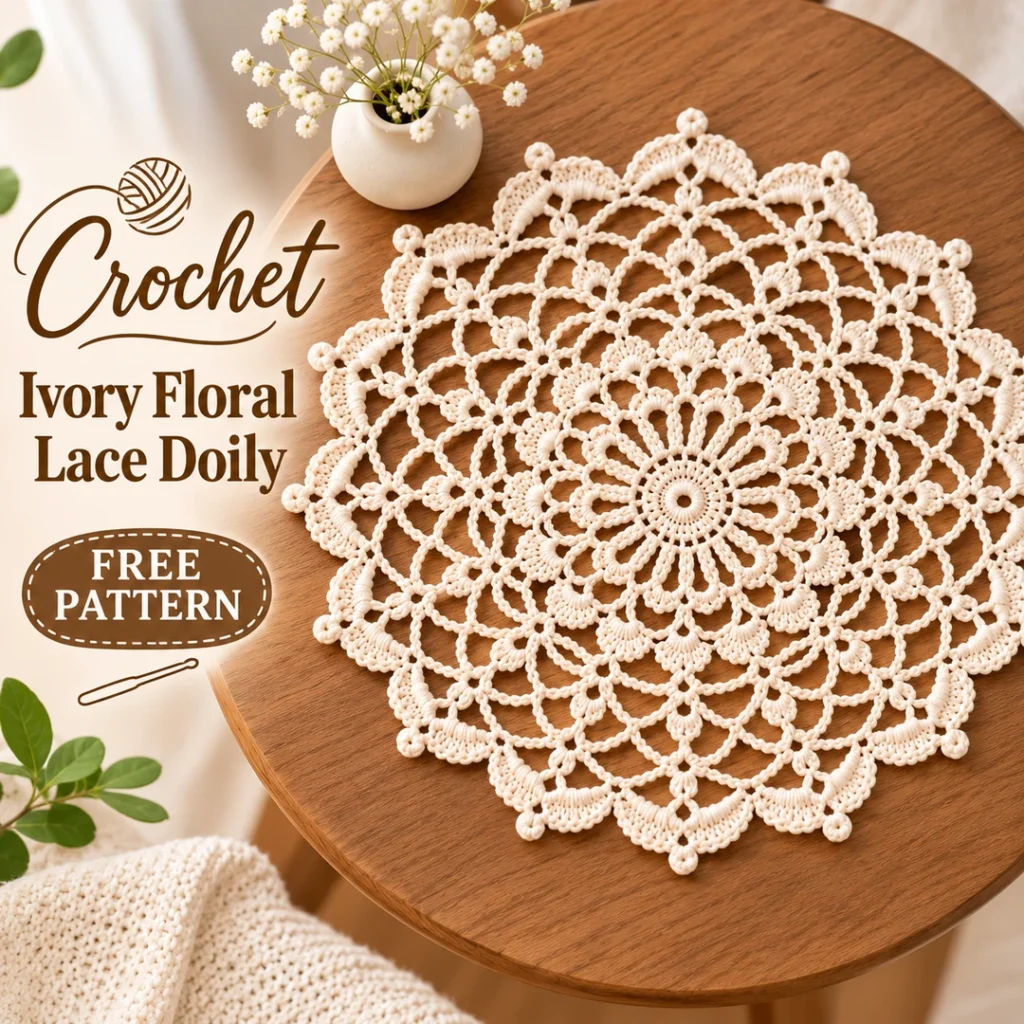
Ivory Crochet Doily With Shell Fans and a Scalloped Edge

Key Takeaways
- The design repeats 16 sections from center to edge: 16 petals, 16 shell fans, 16 outer scallops.
- Rounds 1 to 6 are fully written. Rounds 7, 8 and 9 have missing travel instructions and need a test sample.
- This pattern has not been crocheted and measured. Size and yarn figures are estimates only.
- Estimated finished diameter is 28 to 34 cm (11 to 13.5 in) after blocking, using fine cotton and a 2 to 2.5 mm hook.
- It suits intermediate crocheters who are comfortable reading a pattern and fixing gaps in it.
You find a photo of a gorgeous lace doily, a flower in the middle, soft fans around it, a ring of little scallops at the edge. You click through to the pattern and discover a list of round numbers with half the instructions missing. Sound familiar?
That’s the honest situation with this design, and I’d rather say so up front than hide it. The structure is solid and the first half is clear. The back half is a draft. Here’s exactly what you’re getting, so you can decide whether to test it with me.
Why this crochet doily design works
The whole idea is rhythm. Many doilies add new motifs as they grow, which makes the lace busy. This one keeps the same 16 sections from the first petal to the last scallop. Each section covers one sixteenth of the circle, or 22.5 degrees, so the petals, fans and scallops are meant to line up like a mandala.
The chain arches between the fans get longer toward the edge: ch 11, then ch 13, ch 15 and ch 17. That’s how the circle gets bigger without adding sections. Whether those exact lengths keep the piece flat is one of the things the sample needs to prove.
What you need
- Smooth fine or fingering-weight cotton, or size-3 crochet cotton, in ivory or cream
- 2 to 2.5 mm crochet hook
- Removable stitch marker
- Tapestry needle and scissors
- Blocking mat and rustproof pins
Pick smooth cotton over anything fuzzy. Fuzz hides the stitch definition, and lace lives or dies on definition. Have about 350 m available for the medium version, but treat that as a planning allowance, not a measured figure.
Terms are US. A dtr means yarn over three times, insert the hook, pull up a loop, then yarn over and pull through two loops four times. A ch-3 picot means chain 3 and slip stitch into the first of those chains.
How to crochet the doily, part by part
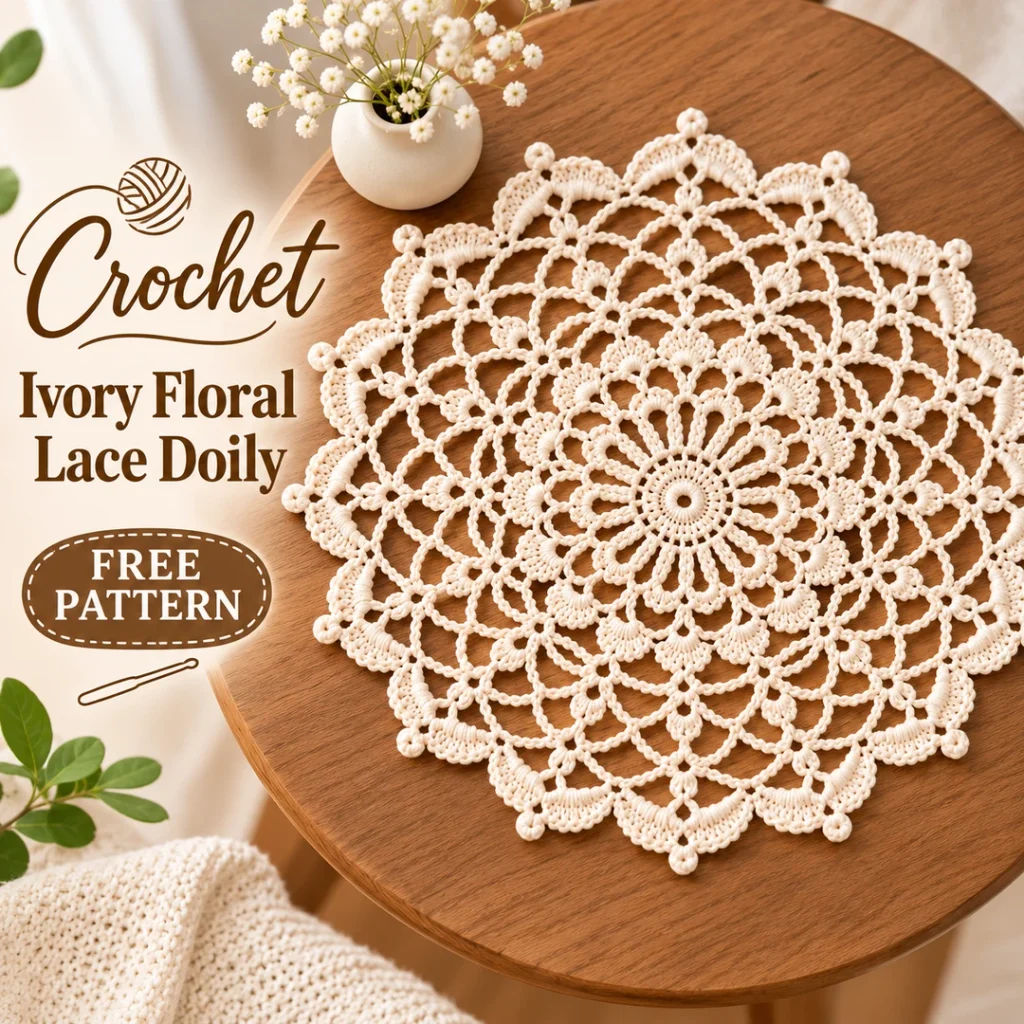
Step 1: Make the center and 16 petals (Rounds 1 to 3)
Make a magic ring, ch 1, work 32 sc into it, join with a sl st to the first sc, and pull the ring closed. In Round 2, ch 1, then repeat sc in the next st, ch 8, sk the next st around, and join. That gives 16 sc anchors and 16 ch-8 spaces.
In Round 3, work this in every ch-8 space: sc, hdc, 2 dc, tr, dtr, tr, 2 dc, hdc, sc. That’s 11 stitches per petal and 16 petals total. Join to the beginning of the round.
Why this matters: the 16 count is set here. If you have 15 or 17 petals, every later round inherits the error, and blocking can’t fix a missing motif.
One caution. The source doesn’t say which stitch to join into for Round 3 or how to travel between petal spaces, so confirm that on your sample.
Step 2: Add the 16 shell fans (Rounds 4 and 5)
Fasten off, then rejoin yarn at a Round 2 anchor sc, working behind the petals. Repeat ch 11, sc in the next Round 2 anchor sc around to get 16 ch-11 arches.
For Round 5, sl st into the first ch-11 space. Ch 3 (counts as a dc), work 8 dc in that space, then sc in the next anchor. Repeat 9 dc in the next ch-11 space and sc in the next anchor around, and join. You should see 16 fans of 9 dc, each pair separated by one sc.
Why this matters: working behind the petals is the part most likely to twist. Check that the arches lie flat before you stitch fans onto them.
Step 3: Build the open lace transition (Rounds 6 to 8)
Round 6 is simple. Begin at a separator sc, then repeat ch 13, sc in the next separator sc around, and join. That’s 16 ch-13 arches.
Rounds 7 and 8 are where the draft gets thin. Round 7 is written as: for each ch-13 arch, sl st along chains 1 to 3, sc in chain 4, ch 15, sc in chain 10, then sl st along chains 11 to 13. Round 8 is the same idea on each ch-15 arch: sl st along chains 1 to 4, sc in chain 5, ch 17, sc in chain 11, then sl st along chains 12 to 15.
Neither round explains how to get from the end of one repeat to the start of the next. Don’t guess your way through it and assume it’s right. Lay the piece flat after each round. If it cups or ruffles, the attachment path is the first suspect, and chain length is the second.
Step 4: Finish with 16 scalloped petals (Round 9)
Work this sequence once in each of the 16 ch-17 arches: sc, hdc, 2 dc, 2 tr, dtr, ch-3 picot, dtr, 2 tr, 2 dc, hdc, sc.
The source says to move between arches with “established connector stitches” but never defines them, and it doesn’t say how to join the final scallop. Those need to be written from a physical sample before this round is publishable.
Round-by-round counts
| Round | Intended count | Purpose | Status |
|---|---|---|---|
| 1 | 32 sc | Center foundation | Written |
| 2 | 16 ch-8 spaces | Petal foundations | Written |
| 3 | 16 petals | Floral center | Join point unspecified |
| 4 | 16 ch-11 arches | Fan foundations | Needs test |
| 5 | 16 fans of 9 dc | Compact fan ring | Closing join needs test |
| 6 | 16 ch-13 arches | First lace transition | Written |
| 7 | 16 ch-15 arches | Second lace transition | Travel missing |
| 8 | 16 ch-17 arches | Outer foundations | Travel missing |
| 9 | 16 scallops | Decorative edge | Connectors undefined |
Size and yarn estimates
| Version | Yarn | Hook | Est. diameter | Yarn to have |
|---|---|---|---|---|
| Small doily | Size-10 crochet thread | 1.5 to 1.75 mm | 18 to 23 cm (7 to 9 in) | About 200 m |
| Medium doily | Size-3 thread or fingering cotton | 2 to 2.5 mm | 28 to 34 cm (11 to 13.5 in) | About 350 m |
| Large table mat | Sport-weight cotton | 2.75 to 3.25 mm | 36 to 42 cm (14 to 16.5 in) | About 450 to 500 m |
All of these figures are unverified estimates. None come from a completed sample. Weigh your yarn before and after your test piece to get real consumption.
Tips for testing, blocking and troubleshooting
Count after every round. You want 16 of whatever that round makes, every time. Lay the piece flat without stretching it, because a doily that cups or ruffles before blocking is telling you something.
If it does misbehave, check where your stitches are attached first. Only then change chain lengths, and change them evenly in all 16 repeats of the affected round. As starting points to test, not guaranteed fixes: try ch 14 instead of ch 13 if Round 6 cups, or ch 12 if it ruffles. For Round 7, try ch 16 if it cups and ch 14 if it’s wavy. For Round 8, try ch 18 if the edge pulls inward and ch 16 if it ruffles.
To block, weave in ends, soak per your yarn’s care label, press out water with a towel (no wringing), pin the center, pin the 16 scallop tips evenly, and let it dry completely. Blocking opens lace and defines scallops, but it can’t repair a wrong stitch path.
Honestly, keep notes as you go: where you joined, what chain lengths you used, finished diameter, yarn used. That’s the data that turns this draft into a real pattern.
Frequently asked questions
How many petals does this crochet doily have?
The design has 16 elongated center petals, followed by 16 shell fans and 16 outer scallops.
Is this doily good for beginners?
No, not in its current form. It needs comfort with working in rounds, tall stitches like the dtr, and lace motifs. The unfinished connecting rounds also mean you’ll have to solve some steps yourself.
Why do the chain arches get longer toward the edge?
They’re meant to cover a larger circumference while keeping the same 16 sections. The exact lengths (11, 13, 15, 17) are the design’s intent and haven’t been confirmed on a sample.
Has this pattern been tested?
No. It’s a written prototype with target counts. Don’t treat the round counts, size, or yarn quantity as verified until someone has crocheted it and recorded the results.
Want to help test it?
Remember that photo with the missing pattern? This post is the opposite approach: here’s what’s solid, here’s what isn’t. If you make a sample, tell me in the comments which round gave you trouble and what you changed to get it to lie flat. I’m especially curious how people travel between arches in Rounds 7 and 8, because that’s the gap that decides whether this becomes a real pattern.